
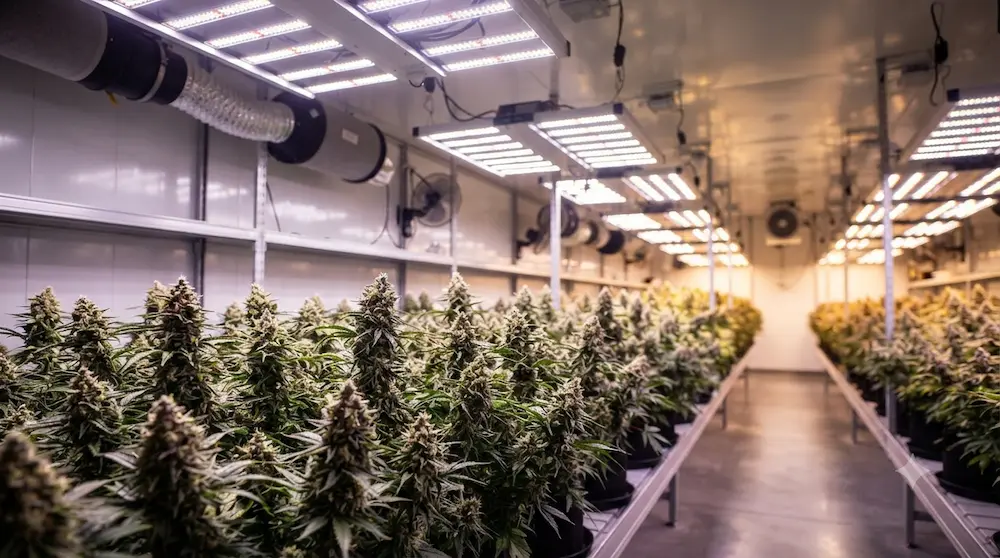

When planning an indoor grow space or selecting seeds for a personal harvest, choosing your genetics is the single most critical decision you will make. For decades, indoor cultivation was almost entirely synonymous with photoperiod cannabis—traditional plants that require a strict shift in their daily light schedule (such as switching from an 18/6 vegetative cycle to a 12/12 flowering cycle) to initiate bloom.
However, the introduction, refinement, and commercial explosion of autoflowering seeds—powered by Cannabis ruderalis genetics—have fundamentally transformed how hobbyists, home growers, and even commercial cultivators approach production. Moving far beyond their early 2000s reputation for low potency and meager yields, modern autoflowers now routinely rival traditional photoperiod strains in quality, flavor, and cannabinoid output.
Understanding the structural, operational, and practical differences between autoflowers and photoperiods is essential for choosing the right genetic blueprint for your grow room.
The Core Genetic Difference: Age vs. Light Cycle
To understand why these two distinct types of plants behave so differently in an indoor environment, you have to look past their physical leaves and examine their internal biological clocks.
- Photoperiod Plants (The Responsive Growers): These plants are short-day organisms rooted in evolutionary history near the equator and temperate zones. In nature, they stay in a continuous vegetative growth state during the long, sun-drenched days of spring and summer, only initiating bloom when late-summer nights lengthen. Indoors, the grower dictates this timeline by manually adjusting digital timers to a strict 12-hours-on, 12-hours-off schedule. As long as you maintain an 18-hour or greater light schedule, a photoperiod plant will remain in the vegetative phase indefinitely.
- Autoflowering Plants (The Autonomous Timer): Featuring genetic contributions from Cannabis ruderalis—a hardy, resilient subspecies native to the short-summer, high-latitude regions of Eastern Europe, Russia, and Siberia—autoflowers run on an internal biological clock. They transition from the vegetative stage to flowering automatically based on age (usually around 3 to 4 weeks after germination), completely ignoring changes or consistency in the external light cycle.
Deep Dive: The Origins and Evolution of Cannabis Ruderalis
To truly appreciate modern autoflowers, it helps to understand where they came from. Cannabis ruderalis was first formally classified in 1924 by Russian botanist D. E. Janischewsky after studying wild populations thriving along the Volga River system and southern Siberia. The term "ruderalis" derives from the Latin word ruderal, which describes plants that aggressively colonize disturbed soils, roadside ditches, and fallow fields.
In the wild, these plants faced immense ecological pressure. With frost arriving early and summers lasting only a few short months, plants that relied on late-summer photoperiod shifts would die before setting seeds. Through natural selection, Ruderalis evolved its day-neutral, age-triggered flowering mechanism to complete its entire lifecycle in as little as 8 to 10 weeks.
While wild ruderalis plants naturally featured low THC levels and sparse, airy structures, early breeders in the late 1990s and early 2000s realized that this autoflowering trait could be "introgressed" into elite, high-THC indica and sativa lines. Decades of meticulous backcrossing, selective stabilization, and large-scale breeding programs have successfully preserved the rapid, day-neutral life cycle while pushing modern autoflower potency well into the mid-20s and low-30s percentage ranges.
Head-to-Head Comparison: Autoflowers vs. Photoperiods
| Feature | Autoflowering Strains | Photoperiod Strains |
|---|---|---|
| Flowering Trigger | Age (fixed internal timer, ~3-4 weeks) | Light cycle change (strict 12/12 transition) |
| Seed-to-Harvest Time | Fast (~8 to 12 weeks total) | Slower (~16 to 20+ weeks depending on veg) |
| Vegetative Control | None (short, predetermined lifespan) | Complete control (weeks to months of veg) |
| Average Plant Size | Compact and discreet (30–100 cm) | Variable, can grow very large (150–200+ cm) |
| Typical Yield (Indoors) | 400–500 g/m² (lower per individual plant) | 500–700+ g/m² (higher per individual plant) |
| Cloning Viability | Impractical (clones share the mother's age clock) | Excellent (easy to maintain perpetual mother plants) |
| Indoor Light Schedule | Constant 18 to 20 hours from seed to harvest | 18/6 during veg, flipped manually to 12/12 for bloom |
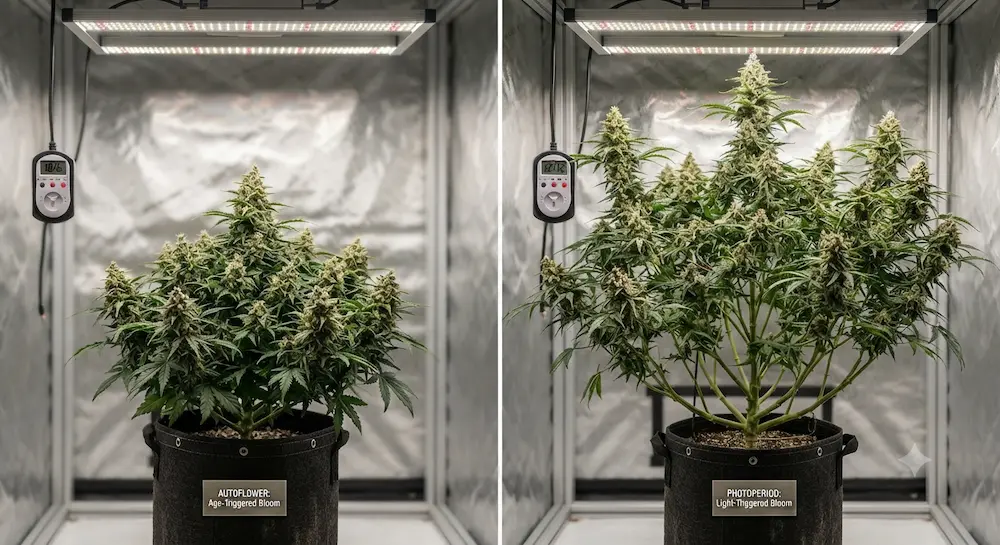
The Distinct Advantages of Growing Autoflowers
For indoor growers prioritizing speed, operational convenience, and tight spatial management, autoflowers offer major cultivation benefits:
- Lightning-Fast Turnaround: Going from a germinated seed to a fully mature, harvested crop in roughly 2 to 3 months allows home growers to cycle through multiple unique harvests per calendar year.
- No Light-Leak Panic: Because autoflowers operate on an internal clock rather than tracking darkness, minor light leaks in your grow room or tent zippers will not stress the plant or disrupt its flowering sequence.
- Stealth and Compact Stature: Their naturally short, bushy frames make them exceptionally well-suited for small grow tents, low-ceiling spaces, or restricted residential setups.
- Simplified Lighting Management: Growers can run indoor LED fixtures on a consistent, unchanging 18/6 or 20/4 schedule for the entire lifecycle, eliminating timer errors during the bloom phase.
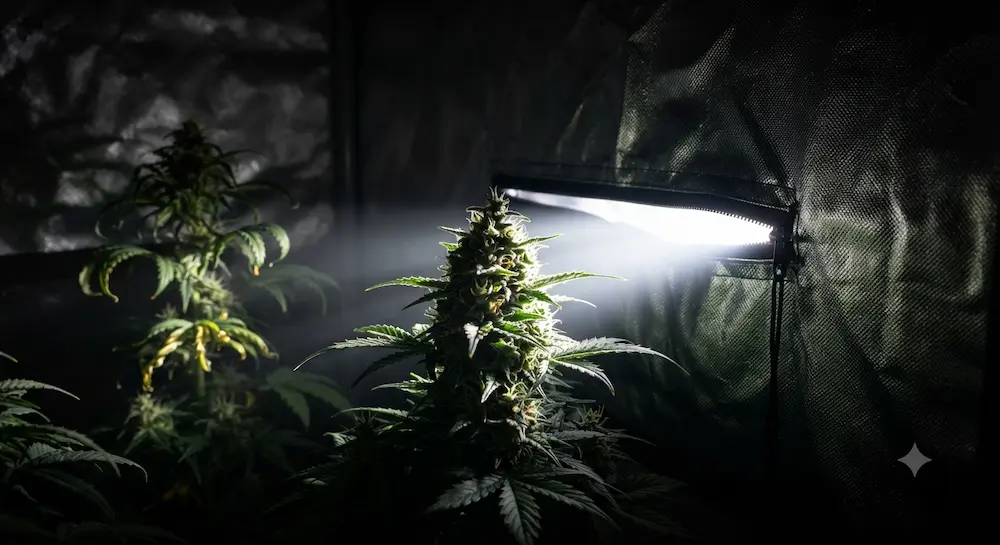
The Enduring Strengths of Growing Photoperiods
While modern autoflowers have closed the quality gap significantly, photoperiod strains remain the gold standard for absolute control, scale, and maximum harvest output:
- Master Control Over Plant Size: Because you decide when to flip the room to a 12/12 schedule, you can keep a photoperiod plant in a vegetative state for months, building a massive, highly structured canopy before triggering flowering.
- Unmatched Yield Potential: A single, heavily trained photoperiod plant in an optimized indoor space can outperform an individual autoflower in total dry biomass and resin collection.
- The Power of Perpetual Cloning: Cultivators can take multiple cuttings from an exceptional mother plant, allowing them to replicate identical, high-performing phenotypes across successive grow cycles.
- Forgiveness and Recovery Buffer: If a photoperiod plant suffers from severe nutrient lockout, pest damage, or physical trauma during its vegetative phase, you can simply keep it in veg until it fully recovers. Because autoflowers run on a strict genetic timer, early stress can sometimes force premature flowering and stunt final output.
Conclusion: Selecting the Right Genetics for Your Space
Ultimately, neither seed category is universally "superior"—the right choice depends entirely on your personal experience level, space constraints, and harvest goals.
Choose autoflowering seeds if you are a beginner looking for a streamlined learning curve, managing a small or discreet indoor tent, or wanting rapid multi-crop turnarounds. Choose photoperiod seeds if you want to push your indoor yields to the maximum limit, practice advanced high-stress training techniques, or maintain a consistent library of cloned mother plants.